45 more days... oh, c'mon!

Robert McLaws writes that apparently pushing back the launch date for Vista 45 more days (enough time for a Beta 3) should do the trick at stabilizing and working out the current issues for Vista.

My comment? Oh please! All the stuff that Robert notes as the things that are wrong with Windows Vista that, he thinks (hopes, rather), can be resolved in that month and a half are stuff that has plagued Windows since the 95 version. The reasons for that stuff is that Window's still monolithic appearing not to be, it's still built upon a browser, the UI is still being designed by engineers (not industrial designers, like it should be), it's still violating every other standard out there to make it impossible to manage. The fact that they are still caring for a launch date, instead of development, makes it obvious that Microsoft is still a business first, a monopoly second, and a software developer third.

A Beta 3 would only stall a launch date, make the users see that this company can't get its act together after all this time, and that, again, Microsoft cannot keep its promises.

But OK, let's say that it's necessary to push the launch date for the sake of the product (and the users, of course)... why only a month and a half? If you want to get it right, push it six whole months, or a year, for that matter. This stuff that you want to resolve won't be resolved in 45 days; it hasn't been resolved in two years! How the hell do you think that another 1080 hours would matter? Microsoft has already pushed it almost a whole year from it's original launch date, why not another, or two? Hell, why not even launch XP SP3 in the process?

If you want an amazing product, the first thing that you need to decide is what's more important: your reputation or your users? Both of them are very important and mutually dependent... Robert wants to mantain both with his comments: delay it, but not too much. I say: if you want a great product, delay it, big time, enough to get your act together; if you want to keep what little good reputation you have left, go for it and keep at least one of your promises! In my opinion, I'd recommend to get your act together and delay it again for a whole year: do a Beta 4, debug your ass off, and show the real abilities of Microsoft... Lord help us if the Beta 2 was it!

Pythagorean Theorem

In my last trip from Queretaro to Juarez (yeah, a lot happenned during that trip, jeje), we left my mom in Chihuahua (she had some family stuff to take care off) so it was only my dad and me in that last four-hour drive to Juarez. Both of us are real math hobbyist, and for some reason we ended up talking about the pythagorean theorem and the fact that neither of us, even though we use it for everything now, haven't seen it's proof in any text book we've read. It's such a used theorem, that it's difficult to think a proof for it. I remembered one, using the areas of the squares formed by the each of the sides of the right triangle, but that it's just a case-by-case proof, I'm more into generalized theorems.

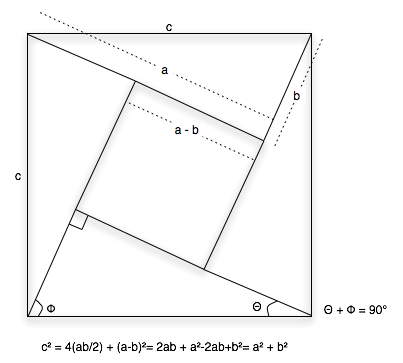
Anyway, I had a small notebook with me so, with three hours of boredom ahead, I decided to prove it. An hour and a half later (which frankly felt more as half an hour), this is what I came up with:

The equation on the bottom starts with an equality of areas: the area of the big square is the square of c, which also is equal to the sum of the area of the four right triangles and the area of the small square; it's just simple algebra from there on.

After I got home, I did a little research and imagine my surprise when I read that this theorem has around 370 proofs, all using from trigonometry, calculus, to finite math. Apparently my proof was actually done around two and half millenium ago, documented in the chinese text Chou Pei Suan Ching done between the year 500 to 200 BC, which right now is the first official documentation of a proof for such theorems; there have been others before, but none of them were documented for that purpose (it was more of a collateral thing in those). Actually, this proof is so famous in China that the Pythagorean Theorem is better known as "Gougu Theorem", based on the numerical proof in the Chou Pei Suan Ching, presented in The Arithmetical Classic of the Gnomon and the Circular Paths of Heaven.

In all fairness, the mayority of those proofs used trigonometry and calculus which, in themselves, use the pythagorean theorem for their own internal proofs (which sounds incongruent). The Chou Pei Suan Ching proof (mine) uses algebra and analytical geometry which doesn't rely on Pythagoras to be proven. So... yeah, I rock, jeje.

[This post was heavily based on the wikipedia article of The Pythagorean Theorem.]

EDIT: After further research I found that the Chou Pei Suan Ching proof was just for the case of the (3,4,5) triangle; it wasn't a general proof like mine. The first person to have actually proven it like I did was the Indian mathematician-astronomer Bhaskara Achārya; you can see evidence of this if you look him up, or in the first Addendum of this page.

The Road from Hell...

In my latest (and probably last) trip from Queretaro to Cd. Juarez, I ran into what I'm now calling the "Almost Road from Hell". 'Almost' because that "Road from Hell", at least for me, belongs to 10 km between Durango and Mazatlan here in Mexico known as the "Espinazo del Diablo" (literally, the Devil's Backbone) and you need a good stomach to withstand it because, well, take a look for your self:

Courtesy of MapQuest

That's an estimate of the land. Look at those curves!

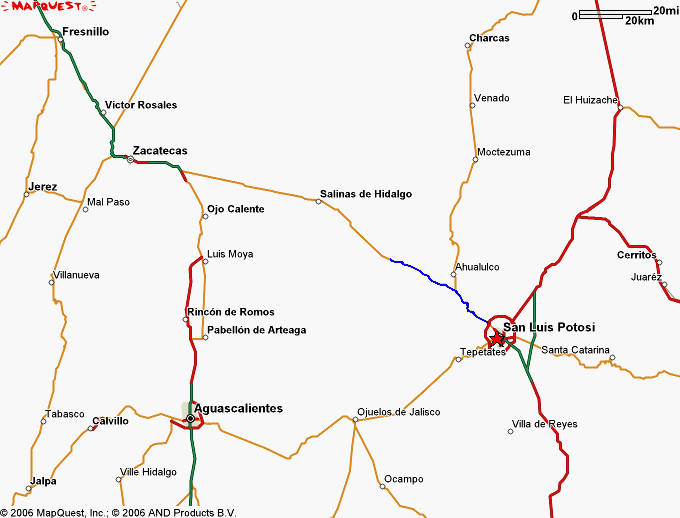
Anyway, the "Almost Road from Hell" is a temporary one (I hope). It's a 65 km long patch of a road starting in the limits of San Luis Potosi city going towards Zacatecas (the blue part):

Courtesy of MapQuest

Compared to the Devi'ls Backbone, it may seem less daunting (which, in retrospect, it is), but don't let that deceive you. This "patch" is being repaired, by little chunks at a time. You're welcomed by repaired chunk 2 to 3 kilometers long followed by an unrepaired chunk 10 to 15 kilometers long, then a repaired one, etc. If you're driving in the repaired chunks, you'll be joyfully driving by speed bumps every other 250 m. That's right, speed bumps in a road equivalent to an U.S. interstate highway, with three lanes going each way (Did I say that they were very wide as well as tall bumps? No? Well, they were). If you're driving in the unrepaired chunks, you'll get one lane going each direction (So, talk about a complete deadlock when entering each one of these!) and speed bumps (yes, also) every other 500 m. Because there are a lot of semis and big trucks transporting stuff very slowly, these three factors (one lane, speed bumps, and slow semis) make it near to impossible to pass them, thus, you're forced to go around 20 km/h (~13 mph) for the length of the unrepaired chunk.

After we cleared it, my dad and I did a little math, and this is what we came up with:

  1. The patch is around 65 km long.
  2. We spend a little over 1 hour and half to clear it (pure hell, I tell you!).
  3. -> 65 km/1.5 h = 43.33 km/h ~ 27mph

This is close to the high speed limit of some residential areas in Mexico!

So, from right now until (I hope) the end of this year: AVOID GOING THROUGH THE SLP-ZACATECAS HIGHWAY, if we could call it that.

GDGraph in "Map my Run"

Well, I'm happy to report that GDGraph is being used quite happily by the Webmaster of Map my Run, which for me is completely encouraging to continue moving on with this project. He's given us credit in the last question of this FAQ.

Who knows? Maybe it'll move on to second place above Libchart in Hotscripts where we stand on third place in the freeware graph PHP classes. First place is quite a long shot: JpGraph is very hard to beat right now, but I'll settle with second for now =).

EDIT: (2010-09-01) I don't know when this happened, but "Map my Run" isn't using GDGraph for PHP anymore. Pity.

Caleb's Definition

—Biblical Data:
According to the Biblical text, Caleb was of the tribe of Judah. He represented that tribe among the twelve spies whom Mosessent from the wilderness to spy out Canaan. He and Joshua alone brought back an encouraging report, and in consequence were the only ones of all that came out of Egypt who were permitted to survive and enter Canaan (Num. xiii. 6, 30; xiv. passim; xxvi. 65; xxxii. 12; xxxiv. 19; Deut. i. 36). After the conquest he was given Hebron and the region around it. In the conquest of this territory he offered the hand of Achsah, his daughter, to the man who would capture Hebron for him; the feat was accomplished and the maiden won by Caleb's younger brother, Othniel. To him was assigned the south land, to which later, at Achsah's request, "the upper springs" were added (Josh. xiv., xv.; and Judges i. passim). His name is connected with several towns in southern Judah (I Chron. ii. passim).J. Jr. G. A. B.

—In Rabbinical Literature:
In the rabbinical sources, Caleb, the son of Hezron (I Chron. ii. 18-20), is identified with Caleb, the son of Jephunneh (Num. xiii. 6), the epithet "Jephunneh" having been given to him because he "turned away" from the sinful intention of the other spies who advised the people against going into the Holy Land. Caleb is also called (I Chron. iv. 5) "Ashhur," because his face became black from much fasting, and "father of Tekoa", because he fastened his heart on God, and in this faith he married the prophetess Miriam, whom, although she was neither fair nor healthy, he treated with fatherly love, appreciating her own piety and her relationship to such brothers as Moses and Aaron.
Although the son of Jephunneh, Caleb is also called "the Kenizzite" (A. V., "Kenezite," Josh. xiv. 6, 14; compare Judges i. 13), because Kenaz, the father of Othniel, was his stepfather; Othniel thus being in fact his half-brother (Soṭah 11a, 12a, where the names of Azubah's children [I Chron. ii. 18] are applied to Caleb in haggadic fashion; see also Ex. R. i. 17).
When Caleb came to Palestine as one of the spies, he visited the graves of the Patriarchs in Hebron (compare Num. xiii. 22) and prayed for their help against the sinful intention of his colleagues (Soṭah 34b). It was also he alone who insisted that the spies should take some of the fruits of the country with them in order to convince the people of the extraordinary fertility of Palestine. As they did not wish to do this Caleb drew his sword and said: "If you will not take any fruit with you, then either my life or yours!" (Tan., Shelaḥ 15, ed. Buber; Num. R. xvi. 14). Thoroughly realizing the evil intentions of the spies, and knowing that it was useless to attempt to dissuade them, he did not betray his plans to them, but acted as if he agreed with them (Tan., l.c. 19; Num. R, l.c. 19). But when the spies began to incite the people against Moses, and hissed Joshua, who attempted to act as peacemaker, Caleb, whom they had thought to be on their side, rose and said, "This is not the only thing the son of Amram has done for us."—here all the ring-leaders were silent—"He has taken us out of Egypt; he has divided the sea for us; and he has fed us with manna. Now, therefore, if he were to command us to make ladders and scale the heavens, we should obey him. Let us go up at once and take possession" (Soṭah 35a; Num. R. l.c.; Tan., l.c.). When the country was divided, Caleb and Joshua received the portions that had been intended for the other spies (B. B. 117b, 118b).
Caleb was the father of Hur from his second wife Ephrath (I Chron. ii. 19), and, therefore, the progenitor of the Davidic house, the "Ephrathite" (I Sam. xvii. 12; Soṭah 11b; Sanh. 69b).J. Sr. L. G.

—Critical View:
The eponymous ancestor of the clan of Calebites. Since "Caleb" signifies dog, it has been thought that the dog was the totem of the clan. Modern criticism finds several different strata to this material, representing different points of view. The oldest writer (J) calls him simply Caleb in Josh. xv. 14-19; and Judges i. connects him with the expulsion of the sons of Anak from Hebron, and with the gift of Achsah and of certain lands to Othniel. D and P call him Caleb, the son of Jephunneh, and make him one of the twelve spies. In the original form of the story he alone brought back the favorable report, and so of all that came out of Egypt he alone entered Canaan.