MPhil leading to a... drumroll... PhD

Well, it's official: I'm a research student.

The teacher of one of the classes that I was attending in the MSc course asked the group who was going to or thinking about doing a PhD in the University of Manchester after finishing. I think it's not needed to write that, well, I was totally there (hmmm, if it's not needed, why did I anyway? Think about it).

The teacher's name, by the way, is Dr. Barry Lennox.

His logic was very convincing: what's your reason to be doing a MSc, other than it being the precesor of a PhD? If it's to get knowledge before hand, that's what you do in your first year of the PhD anyway: actually, the program that you can get into if you don't have a masters degree is "MPhil leading to a PhD" which will grant you a MPhil in the first year.

Brief parenthesis: there's a big difference between a MSc and a MPhil. A MSc is a taught program, meaning going to classes and doing a small dissertation project in the last three months of the 15-month period. A MPhil is a research program, meaning reading, reading, reading, and doing a small thesis about the findings at the end of the one- to two-year period. Both give a masters degree, but a MSc degree is a little more prestigious than a MPhil in the U.K, mainly because of the fame that it has brought on to itself of being "the degree that is given out when someone doesn't complete a PhD". Although, in my perspective, being that a MPhil is research-based, in Mexico, where it doesn't have that fame, it should be the other way around.

And that leads to Dr. Lennox's second point: if some reason you don't find any funding for the last two years (which, considering the 300% increase in tuition fees for foreigners, is viable), the University will still give you a masters degree to go back and boast about. Taking care, at the same time, of the fact that you'll have to pay for just three years of tuition fees, not four (£11,000 less to pay is always good).

To finish off his argument he mentioned that if you're seeking funding, you need to apply during this year to have the whole process finish by the time you finish the MSc (around the end of next year). And if you're applying for help to fund a PhD, the scholarship organizations will ask for a summary of the project that you're going to be developing; if you have this already, why not start working on it now?

It was hard to ignore the opportunity, but one thing was bugging me: I didn't have a project to work on. That was the point of doing the MSc first: get an idea of what can be done. I went to talk to Dr. Lennox anyway, and he first asked of my qualifications: I mentioned my bachelor's degree GPA (94/100) and that I have my own company, Makko Solutions. Apparently that was enough for him: "You're in. What projects do you have in mind?" I was completely stumped. I explained the whole situation and he replied that I should think of some ideas in the next couple of days, of what interests me, what area is the one that I would like to get into, and to read what the staff have dwelled about to also get a feel of who would I like as a supervisor; I wasn't even a research student, and I already had an assignment.

I was actually quite impressed with the amount of ideas that came about. I never realized that I have had stored so much stuff in my little nugget. I first read of what the staff have written about, which was glaring: very diverse stuff, really. But I settled on two: Dr. Heath and Dr. Lennox. They have written about a subject that I've always heard about and that sounds interesting: Model Predictive Control, MPC, and justs as it sounds, predicting to satisfy every state of the controlled process (to read more: go here). It also implies controlling non-linear models (which in classical control is VERY hard) with more than one input/output (also a pain).

The ideas that I most liked where the following:

  1. Using MPC as an optimizer of the process of coming up with a solution by genetic algorithms.
  2. Global-Positioning-System-based guidance system as a control problem solved by MPC.
  3. Quality control by MPC.
  4. Flying Saucer project.
  5. Using MPC for fault monitoring in the Intelligent Guitar Effect Box project.

All of these are quite hard to explain in layman's terms, because of the specialization that they involve, but I'll try:

The first one. Genetic algorithms is an artificial intelligence concept, which, of what I've read, it's the standard of comparison for other problem-based solution-finding algorithms. The problem is it's speed, because it relies on evolving over all the possible scenarios (no matter how improbable they are), so I'm proposing using MPC to optimize it and speed it up by trying to predict the way it will evolve the quickest. The interesting point of this is that usually AI is used as a tool for control, but this proposition reverses that, using control as a tool for AI.

The second one. Putting the reference point of the system to be the desired position of a vehicle and the observed variable being it's current position (all this GPS driven), use MPC to not only solve the positioning problem, but also try and predict problems and obstacles ahead.

The third one. If you're from the industry, quality control must be day-in and day-out concept for you. I would like to see if MPC fits in there and what advantages can it bring out.

The fourth one. I always thought that flying saucers were possible to make: by a fan controlled by a motor and counterweights in it's edge, not by the center. MPC will be used to handle height control and direction.

The fifth one. This was just to try and include my hobby in the whole thing: imagine a guitar effect's box that you teach your song to, and the box will learn WHEN, in the song, to put WHAT effect. Now, when you go on stage, just plug it in and you don't have to come back to step on pedals to apply the next effect. Obviously, because we always play a song differently everytime, the box needs to predict and compensate for any error in tuning and/or timing whilst playing live.

I met with Dr. Lennox with the ideas in hand, and was very surprised that he was very interested in the fifth one... yeah: the guitar one. He mentioned that he had started working on a game which would teach a person how to play a certain song, like the dancing games you see in every arcade, but with any type of guitar. That actually fitted well with my project, but he instated that it's very important to keep an open mind on where the project may lead. It's very possible that this project, or it's findings, may be applicable to other areas that aren't sonic analysis, and, thus, don't get too attached to it because it may change over time. Almost as in queue, here comes a bank, yes, a bank that has grown interest in the project and it's feasibility of applying it to credit account owners and/or the accept/reject process of getting one.

It's now being about a month of "working"... it's been confusing, really. A lot of new terms to understand, therefore a lot to read, and always thinking on where to apply it. Right now I'm finishing reading on Principal Components Analysis, PCA, and it's meaning (for more information, go here), Wikipedia rocks!). It's something that took more than two weeks of banging my head against the wall to understand, but it's worth it, because now I know that PCA can simplify my life in the near future.

Now that I'm full on this thing, as Dr. Lennox predicted, we have slowly changed course of where I'm going. It's ok though, I prepared myself for it and was expecting it: many other students that I've talked to have said that the original topic of research of a thesis is never the same as it is on when it's being written up. I'll probably wind up using this project as a training application of the terms that I'm reading upon and writing up something in System Modelling which is beginning to appeal to me. Coincidentally, that is what the bank is interested in.

I'm ok here... confused, but apparently is normal. I've never found comfort in confusion, there's no control there, but irony is now my way of life and it looks comforting =)

What if everything around you
isn't quite as it seems?
What if all the world you think you know
is an elaborate dream?
And if you look at your reflection,
is it all you wanted to be?
What if you could look right through the cracks?
Would you find yourself
find yourself afraid to see?

What if all the world's inside of your head
just creations of your own?
Your devils and your gods,
all the living and the dead,
and you really are alone.
You can live in this illusion.
You can choose to believe.
You keep looking but you can't find the woods,
while you're hiding in the trees.

Good song...

Rant 2006-10-19: MSN Messenger for Mac, Microsoft Doesn’t Get It

Notes before reading:
*For an explanation on how this rant is organized, please: read this.
*This rant is posted in the comment section of this blog's post.
-Sorry for my disappearing act: I'm doing a PhD over at the University of Manchester, so my leisure time has decreased exponentially during these last few months. I may change the publishing period of these rants to a monthly thing, instead of a week, sorry about that.
-Anyway, the topic of the blog was of the launch of the new version of MSN Messenger for the Mac (6.0.1) and the absence (still) of A/V support for PC MSN users.
-My rant is mainly as a response to one pro-Microsoft comment that was from Johnathan Wise saying:

No dude, you don’t get it. Microsoft even published a blog post on this release to explain things to people like you. In order to add new features, such as A/V, Microsoft had to have a stable code base to work with. They didn’t originally write the software in XCode, so make a universal binary was nearly impossible. It would be stupid for them to add new features on that old, non-compatible code base, so the first priority was to move to XCode and release a Universal Binary. This gives them a compatible, future-friendly code base off of which they can begin to add new features.

I’m not saying Microsoft has properly prioritized Messenger for Mac. I too have been frustrated by the lack of features. But they are “getting it” and they are moving in the right direction. And Apple shares some fault for not communicating in advance their plan to go “Universal.” They recommended using XCode, but didn’t tell anyone why, and a massive software house like Microsoft isn’t going to just switch development environments without good reason.

Now they have good reason, Apple’s strategy is clear, and they can begin making progress. Ya, they’ve been slow, but now that they’re doing the right thing, cut them some slack!

-You can find the Microsoft blog post he mentioned here.
-A/V means Audio/Visual. Y'know: using the webcam and microphone in your computer to see/talk to another person by MSN. You can't do that with a Mac to a PC user through the MSN protocol, you have to use something else, like Skype, SightSpeed, etc.
-XCode is the official (and probably only) development environment to create Mac applications.
-Universal Binaries are applications that can run natively on both Intel- and PowerPC-based Macs. It's a source of frustration for most users that have Intel-based Macs because there are many applications right now that aren't Universal, so they don't run as fast as they do on a PowerPC-based Mac, including Office, Adobe Photoshop, and, until a month ago, MSN Messenger for Mac.

Rant:
Actually, Steve Jobs in the 2005 WWDC, made it very clear why should Apple Developers should use XCode 2.1 (or later): to make Universal Binaries of the programs. Apple did this over half a year before the Intel Macs were shipped and it also made some Intel Macs available for developers to test on before hand. Even the General Manager of Macintosh Business Unit of Microsft, Roz Ho, made a little speech in which, and I quote “We’re releasing a new version of MSN Messenger for Mac in the next few months” followed by stating that they are working with Apple to create Universal Binaries of Office with XCode. So, they had known about this well before. Actually, Adobe did exactly that and has now put up a shipping date (Spring 2007) for Photosho CS3 which would be Intel-compatible for Macs.

So you see, there IS a good reason for them to switch development environments, Apple gave them all the tools and support for such (as it did for every other developer), and still they haven’t delivered; not completely anyway. They DID release a new version of MSN Messenger but, come on, the new features we’re really poor: it’s more of a 5.2 than a 6.0.1 in my opinion. This isn’t news, really: the browser-based messenger can’t run on a Mac because of Microsoft’s choice; they have dropped Virtual PC development; and didn’t they dropped support for Messenger for the Mac a while ago? And now they’re back, who knows what’s going on in there?

Frankly, stick with third party applications for MSN chatting and use something else to conference with. I use SightSpeed, someone else mentioned Skype, they get the job done; and right now Microsoft it’s not doing that, whatever the reason (they have to launch Vista, make Office Intel compatible, etc.), this is showing that Mac users aren’t a priority for Microsoft, and well, duh! I wouldn’t care if iTunes crashed on a Windows PC, and, although Apple is doing a somewhat decent job on that point, it’s not a priority for them either.

You want to use a Mac? Research what’s out there, and get something that works in the third party area; don’t sit around and expect Microsoft to run to your rescue.

Just Three Letters

I have been searching for a way to share my ideas that I've put into recording. For now this is the best that I've found. Click here, or the title, to go to one of box.net public shares in which I've made available to download the tracks of my demo "Just Three Letters". Hope you like it, and please comment; I'm very interested in your opinions.

Box.net offers quite an interesting value at no charge. There's an upgrade that gives out more stuff, which you have to pay for, but the free package comes with 1 Gb of storage, and no uploads larger than 10 Mb, which for most people wouldn't be a problem.

Diversity

The way the society works is very much the same as everywhere in the world; at least from the perspective I've learned during these weeks. I'm not saying this is really how it works (I don't think nobody knows that for real), but, because of the diversity of culture that Manchester is famous for, this fact is hard to ignore.

There are people here, literally, from all over the world: name a country, there is a "town" here for them. China, Pakistan, Oman, Mexico... but the incredible thing is that, even though it should be a disaster waiting to happen (so much culture clash), is not. People get along, people discuss about taboo subjects (religion and politics) and, for the most part, reach a very amigable conclusion. You see people from New York talking with muslims about 9/11 and how it affected both cultures. A lot of doubts are cleared about the stereotypes that have been stated about different societies and most of them come with a pleasant and enlightening surprise:

  • India was made up by different tribes and "countries" before the British came and unified them in one. The languages of each of the old countries still remains though, and, even though English and Hindi are the country's main languages, about less than 30% of them actually speak or understand Hindi, making English probably the most spoken language in the country. That's why you see so many indians (a term that they are comfortable with) in U.S.A, U.K., Canada and Australia: they are english-speaking countries.
  • The basic definition of the Islam is believing in God in a way that trascends man and his form. There are no forms or images given to God, even Muhammad (the religion's main, and probably only prophet) himself petitioned his followers not to remember his image but only the words that God spoke through him. It takes consideration of the Christian and Jewish religion and accepts them as part of the prophecies that God gave to mankind, and Islam being the last of them and, thus, the purest. From a logical point of view, that makes sense: have you ever heard a man tell an anecdote that happenned to him 50 years before? It sounds extraordinary, when it really probably isn't, but the time that's passed made it a little bit blurry so he has to make up for it by filling in the blanks of what he thought happenned. I'm not saying Christianity and Judaism are distorted or anything (who am I to say that?) but, from this take, Islam is a fresh look in things, and that gives it a very good standing point in my opinion.
  • War and violence is frowned upon... to hurt another person is to hurt humanity itself. I love that, so many people saying that the war that's hapenning over there, and way over there is just, basically and utterly wrong. I'm not saying any names, not because I don't want any controversy, you know I like that, but because I'm really bad in geography and history.
  • The openness of questions and the actual need to inform about one's culture is engraved into our brain. Maybe it's pride, maybe it's altruism, but the matter of the fact is I've learned a lot mainly by the motivation of the persons of the same cultures that I'm learning about. Not that I need more motivation to do that, but these people actually come up to me and ask "Do you have any questions?" without me saying a word, which not only makes the whole situation much more civil but also is very inspiring.
  • There's always a lot of ways of seeing a situation... you don't have the answer, we all do.

London

When I reread the post "Direct Debit and Me" I realized that, well, it got a little out of hand. Sorry for that, I tend to go ballistic when it comes to writing.

To compensate for that I'll try not to write that much in this post, but rather put a lot of pictures of my visit to London and the Apple Store. This works very well for me, being that it's almost five minutes before class, jeje. Take in consideration that we had only about eight hours to visit, so don't expect that much detail of the stuff that we saw. I'm definitely visiting London and Liverpool later into the year with more time in my hands.

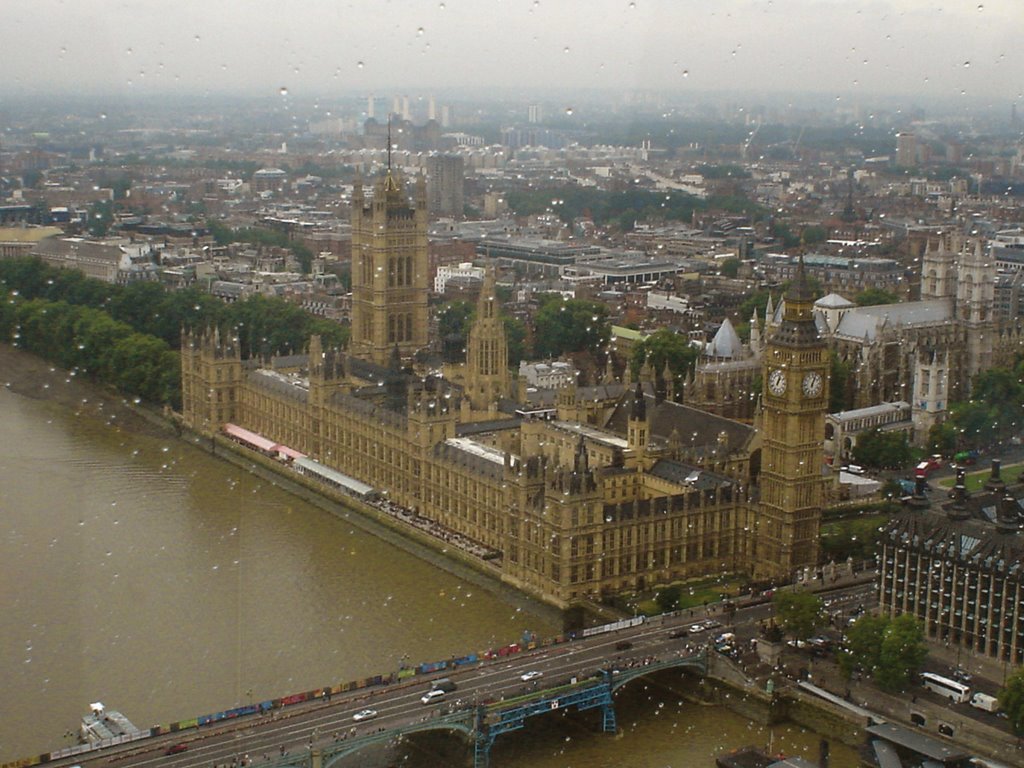
Ok, first and foremost: the House of Parlament and Big Ben (which's the name of the bell, not the tower, apparently), taken from the Eye of London's point of view:

We then went to Buckingham Palace. These are the gates of one of the Royal Parks which are exactly in front to the left of the palace:

The Buckingham Palace itself (I loved the sky that day):

The Victoria Memorial (in memory of Queen Victoria, who reigned the longest any other monarch has in U.K.'s history, 63 years... and we thought Porfirio Diaz had a long run):

Next, whilst trying to find one of those famous red buses to continue on our journey, we encountered this statue that some mistake as a statue in honor of Napoleon (yeah, that Napoleon) but rather it's actually in honor of the british admiral that beat him during the Battle of Trafalgar, Admiral Lord Nelson (actually, the place in which this statue is located is called Trafalgar Square):

During the bus ride, I finally got to see one of the three things I wanted to see in this London's visit; one being the House of Parlament, the second being the Apple Store, (which's coming, I promise), and the third being the St. Paul's Cathedral. I don't know why it just me drew me to it:

And... (I love how this one came out)

When we went through Regent Street, we hoped off to eat, I crossed the street carefully as noted here (hilarious, isn't it?):

I quickly went into the Apple Store, in which I bought an automatic light for my iSight (yeah, I'm a Mac fan, I had to buy something, jeje):

And to finish off, we had to have the stereotipycal scottish (not british) bagpipe player doing Classic Lullaby in D Major to an infant wishing for £1 from his mum (cool guy, though, and he really played well):

That's it! I promise I'll visit again with more in-depth pictures of the House of Parlament and of the fourth thing I wanted to see but didn't in this visit: Old Bailey, for all the V for Vendetta fans out there (yeah, Hugo, this means you).